
Visiting St. Peter's Church in St. George's, Bermuda
St. Peter's Church, founded in 1612, is the oldest Anglican church outside the British Isles and the oldest Protestant church in continuous use in the New World. It sits on Duke of York Street in the centre of St. George's, a short walk from St. George's Club. Entry is a suggested $2 donation per person.
Few places in the Atlantic carry 400 years of history as quietly as St. Peter's Church. Its whitewashed walls, cedar doors and simple bell tower look modest from the street. Step inside, though, and you are standing in the spiritual heart of Bermuda's first permanent settlement.
For guests of St. George's Club, St. Peter's is the natural first stop on any walk through town. It sits within the UNESCO World Heritage Site of St. George's, and it sets the scene for everything else you will see nearby.
A church as old as the settlement
St. George's was founded in 1612, three years after the shipwreck of the Sea Venture brought English settlers to Bermuda's shores. The first church on this site was a simple structure of wooden posts and a palmetto-leaf roof. Storms took it down, and the settlers rebuilt.
The oldest surviving parts of today's building date from around 1620. The church has been altered and extended many times since, which is part of its charm: each century has left a layer you can still read in the stone and timber.
In 1620, Bermuda's first Parliament met here. That makes St. Peter's not only a place of worship but also a founding site of one of the oldest parliamentary traditions in the Western Hemisphere.
What to see inside
Take your time once you are through the cedar doors. Look for:
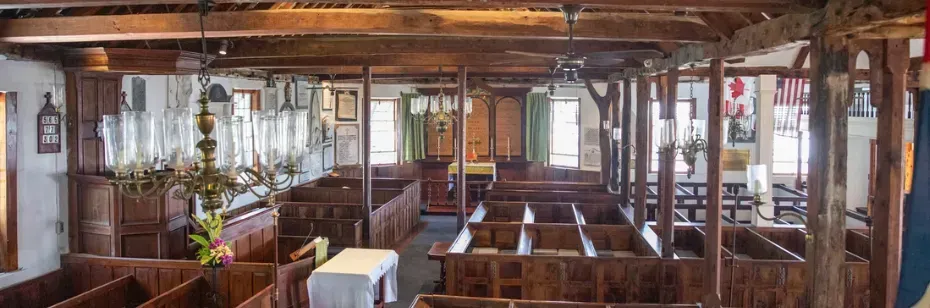
- The altar, carved around 1615 under Bermuda's first governor, Richard Moore. It is considered the oldest piece of woodwork on the island.
- The cedar ceiling, built in a way that echoes the ribs of a ship's hull — a nod to the island's seafaring roots.
- The font, believed to have been brought to Bermuda by the first settlers.
- Memorial tablets on the walls, which trace centuries of island families, governors and sailors.
Volunteer guides are often on hand and happy to share stories. Ask about the church's royal title: in 2012, Bermuda's 400th anniversary year, it was granted the designation "Their Majesties Chappell," a name first used in the 1690s.
The churchyards and Bermuda's Black heritage
St. Peter's has two churchyards, and their history matters. In the colonial era, enslaved and free Black Bermudians were buried separately from white parishioners. Today the church is a stop on the African Diaspora Heritage Trail, which traces the legacy of slavery and the contributions of Black Bermudians across the island.
Walking the grounds is a quiet, reflective experience. It adds depth to a visit that might otherwise feel like a postcard.
Planning your visit
- Address: 33 Duke of York Street, St. George's GE 05
- Admission: $2 per person, as a donation
- Opening hours: 11 am – 3 pm (confirm days before visiting; see note in Series notes)
- Phone: (441) 297-0216
- Website: stpeters.bm
St. Peter's is an active parish church, so services and special events can close it to sightseers. Dress respectfully, keep voices low, and ask before photographing anyone at prayer.
Pair it with a walk through town
St. Peter's sits just off King's Square, so it is easy to build a half-day around it. Start at Town Hall, then climb the steps to St. Peter's. Continue up Government Hill Road to the ruins of the Unfinished Church, and finish with lunch on the waterfront. Every stop is within walking distance of the hotel.
Four centuries of building in one church
Part of the fun of St. Peter's is reading its many layers. The first settlers built quickly, with what they had: cedar posts, palmetto thatch and local limestone. Hurricanes regularly undid their work, and each rebuild left the church a little sturdier and a little more distinctly Bermudian.
Much of the building you see today took shape in the 18th century, after storm damage forced major reconstruction. Later additions, including the tower, followed as the parish grew. Inside, you can still see how builders adapted English church design to island conditions: thick walls to resist storms, small windows against the heat, and cedar used wherever possible because it was strong, fragrant and resistant to insects.
The result is a church that feels both familiar and unusual to visitors from Britain or North America. It is recognisably Anglican, yet unmistakably shaped by the sea, the weather and the materials of a small Atlantic island.
People and stories in the churchyard
The churchyard is an open history book. Headstones mark generations of St. George's families, mariners lost at sea and colonial officials who served far from home.
The graveyard also holds a more recent and sombre chapter. Bermuda's Governor, Sir Richard Sharples, and his aide-de-camp, Captain Hugh Sayers, were killed in 1973 and are buried here. Their graves are a reminder that St. Peter's is not a museum piece but a living parish whose story continues into modern times.
As you walk, notice the separate burial areas described above. They tell a difficult but important part of Bermuda's past, and many visitors find them the most memorable part of the visit.
Why St. Peter's matters to Bermuda
For Bermudians, St. Peter's is more than a historic building. It is where the island's first Parliament met in 1620, where generations of families have been baptised and married, and where the town gathers for major occasions.
It is also central to St. George's status as a UNESCO World Heritage Site. UNESCO recognised the town as an outstanding example of an early English colonial settlement in the New World, and St. Peter's is among its most important surviving buildings.
When Bermuda marked the 400th anniversary of the founding of St. George's in 2012, the church was at the heart of the celebrations. The royal title "Their Majesties Chappell" was granted that year as a gift, linking the church back to its 17th-century royal connection.
Photography tips
St. Peter's is one of the most photographed buildings in Bermuda. For the best shots:
- Shoot the façade from the bottom of the steps to capture the full sweep of the stairway, doors and tower.
- Visit in the morning, when the whitewashed walls are evenly lit and the street is quiet.
- Inside, turn off your flash. Natural light through the windows shows off the cedar beams far better.
- Look up. The ship's-hull ceiling makes a striking image from the centre aisle.
Always be respectful. Some visitors come to pray, and photography may not be welcome during services or private moments.
More history within a few minutes' walk
St. Peter's is surrounded by other heritage sites, so it is easy to fill a morning:
- Tucker House, a Bermuda National Trust museum in an 18th-century merchant's home, with period furniture and Bermuda cedar pieces.
- The St. George's Historical Society Museum, set in a house built around 1700, showing what early colonial life looked like.
- The Bermuda National Trust Museum on King's Square, with exhibits on the town's past.
- The narrow lanes of the old town, such as Barber's Alley and Petticoat Lane, which reward slow wandering.
Check opening hours for each museum before you go, as many keep shorter hours than the church.
Best time to visit
The church is quietest in the late morning, shortly after it opens. Cruise ship days can bring tour groups into St. George's, so if you prefer calm, plan your visit for a day when no ship is in port or go early in the visiting window.
The shoulder seasons of spring and autumn are especially pleasant for walking the steep streets around the church, with milder temperatures than the height of summer.
How old is St. Peter's Church in Bermuda?
The church was established in 1612. The oldest surviving parts of the current building date from around 1620.
Is St. Peter's Church free to visit?
Visitors are asked for a $2 donation per person.
Can I attend a service at St. Peter's?
Yes. It is an active Anglican parish, and visitors are welcome at services. Check the church website for current times.
How far is St. Peter's Church from St. George's Club?
It is a short walk downhill from the hotel into the centre of town.
Is St. Peter's part of the UNESCO World Heritage Site?
Yes. It lies within the Historic Town of St. George and Related Fortifications.
Stay steps from Bermuda's oldest church
St. George's Club puts you within walking distance of St. Peter's and the whole historic town. Explore our cottages or book your stay and start your Bermuda story where Bermuda's own began.